
When do we use a 4 poles circuit breaker instead of a 3 poles circuit breaker?
Posts by vozwei Categories: Knowledge Published On: June 5, 2026 14 min read
1.Introduction.
This article will delve into the role of circuit breakers and explain why they need to be classified. We will explore in detail the differences between three pole circuit breakers and four pole circuit breakers, as well as their applications in different scenarios. In addition, we will also share some practical case studies to help you better understand when circuit breakers need to be replaced, and provide some advice and experience to ensure that your electrical system remains safe and reliable at all times.2. Circuit breaker.
Q: What is a circuit breaker?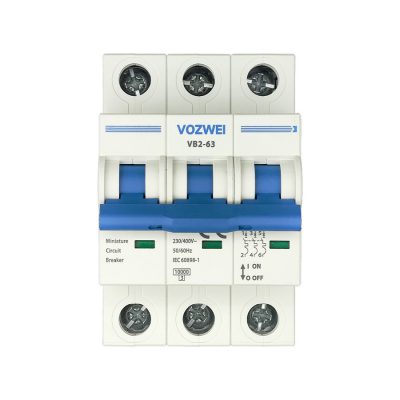 A: A circuit breaker is an electrical switching device used to protect circuits and equipment, mainly used to cut off the current in the circuit to prevent damage or danger caused by overload, short circuit, and other faults. Widely used in power systems and various electrical equipment.
The circuit breaker automatically opens the circuit and cuts off the current when the current exceeds the set value through internal electrical components and mechanical structures to protect the circuit and equipment. After the fault conditions disappear, the circuit breaker can be manually or automatically restored to the closed state to resume current conduction.
The main functions of circuit breakers include:
(1). Overload protection: When the current in the circuit exceeds the rated value, the circuit breaker will automatically open and cut off the current to avoid damage to wires and equipment due to overheating.
(2). circuit protection: When a short circuit occurs in a circuit, that is, when the current abnormally rapidly increases to a very high level, the circuit breaker will quickly cut off the circuit to prevent damage to wires and equipment due to a short circuit.
(3). voltage protection: The circuit breaker can monitor the voltage level in the circuit, and when the voltage is below the set value, it can prevent the circuit from starting to prevent unstable or damaged equipment operation.
(4). Overvoltage protection: The circuit breaker can detect the overvoltage situation in the circuit. When the voltage exceeds the set value, the current can be cut off to protect the equipment from damage and electric shock.
(5). Ground fault protection: When a ground fault occurs in a circuit, that is, when the current flows back to the ground through an unexpected path, the circuit breaker will quickly cut off the circuit, ensuring personal safety and equipment integrity.
Circuit breakers typically consist of contacts, switch mechanisms, protective devices, and spring mechanisms. Contacts are key components in circuit breakers, responsible for conducting current in the closed state and blocking current in the open state. The switch mechanism is used to manually or automatically operate the switch state of the circuit breaker. The protection device is the core part of the circuit breaker, which monitors the circuit status in real-time by detecting parameters such as current and voltage, and triggers the action of the circuit breaker in abnormal situations. The spring mechanism provides the necessary mechanical force to enable the circuit breaker to quickly cut off the current.
According to different application fields and requirements, circuit breakers come in various types and ratings. For example, low-voltage circuit breakers, medium voltage circuit breakers, and high-voltage circuit breakers. Low voltage circuit breakers are mainly used in households, industrial and commercial buildings, and small industrial equipment. Medium voltage circuit breakers are suitable for urban distribution networks and industrial power systems, while high voltage circuit breakers are usually used in substations and transmission lines of power systems.
In short, circuit breakers are a crucial electrical device that can quickly cut off current in the event of a fault, protecting the safe operation of the circuit and equipment. By selecting and correctly applying circuit breakers, electrical accidents can be effectively prevented and reduced, and the reliability and stability of the power system can be improved.
Q: Why do circuit breakers need to be classified?
A: The grading of circuit breakers is to meet the safety requirements of different power systems and electrical equipment. Usually, circuit breakers are classified based on their rated voltage and rated short-circuit current parameters. A higher rating means that the circuit breaker has greater carrying capacity and higher safety level.
Firstly, the rated voltage of circuit breakers usually matches the voltage level of the power system or equipment. For example, low-voltage circuit breakers are suitable for circuits and equipment with a rated voltage below 1000V, while high-voltage circuit breakers are suitable for power systems with a rated voltage above 1000V and up to hundreds of thousands of volts.
Secondly, the classification of circuit breakers is also related to their rated short-circuit current. Rated short-circuit current refers to the maximum short-circuit current that a circuit breaker can safely cut off. Therefore, in circuits and equipment, the larger the short-circuit current, the higher the rating of the circuit breaker needs to be used to ensure safety.
In addition to the above reasons, the grading of circuit breakers is also related to various factors such as their application situation, environmental conditions, load type, and protection requirements. For example, in certain special environments (such as oceans, plateaus, etc.), it is necessary to choose circuit breakers with higher ratings suitable for that environment to ensure their reliability and durability.
In summary, the grading of circuit breakers is based on the actual needs of different power systems and electrical equipment to ensure their safe and reliable operation. Choosing appropriately graded circuit breakers can improve the safety and stability of electrical equipment and power systems.
Q: What is a 3-pole circuit breaker and a 4-pole circuit breaker?
A: A circuit breaker is an electrical switching device used to protect circuits and equipment, mainly used to cut off the current in the circuit to prevent damage or danger caused by overload, short circuit, and other faults. Widely used in power systems and various electrical equipment.
The circuit breaker automatically opens the circuit and cuts off the current when the current exceeds the set value through internal electrical components and mechanical structures to protect the circuit and equipment. After the fault conditions disappear, the circuit breaker can be manually or automatically restored to the closed state to resume current conduction.
The main functions of circuit breakers include:
(1). Overload protection: When the current in the circuit exceeds the rated value, the circuit breaker will automatically open and cut off the current to avoid damage to wires and equipment due to overheating.
(2). circuit protection: When a short circuit occurs in a circuit, that is, when the current abnormally rapidly increases to a very high level, the circuit breaker will quickly cut off the circuit to prevent damage to wires and equipment due to a short circuit.
(3). voltage protection: The circuit breaker can monitor the voltage level in the circuit, and when the voltage is below the set value, it can prevent the circuit from starting to prevent unstable or damaged equipment operation.
(4). Overvoltage protection: The circuit breaker can detect the overvoltage situation in the circuit. When the voltage exceeds the set value, the current can be cut off to protect the equipment from damage and electric shock.
(5). Ground fault protection: When a ground fault occurs in a circuit, that is, when the current flows back to the ground through an unexpected path, the circuit breaker will quickly cut off the circuit, ensuring personal safety and equipment integrity.
Circuit breakers typically consist of contacts, switch mechanisms, protective devices, and spring mechanisms. Contacts are key components in circuit breakers, responsible for conducting current in the closed state and blocking current in the open state. The switch mechanism is used to manually or automatically operate the switch state of the circuit breaker. The protection device is the core part of the circuit breaker, which monitors the circuit status in real-time by detecting parameters such as current and voltage, and triggers the action of the circuit breaker in abnormal situations. The spring mechanism provides the necessary mechanical force to enable the circuit breaker to quickly cut off the current.
According to different application fields and requirements, circuit breakers come in various types and ratings. For example, low-voltage circuit breakers, medium voltage circuit breakers, and high-voltage circuit breakers. Low voltage circuit breakers are mainly used in households, industrial and commercial buildings, and small industrial equipment. Medium voltage circuit breakers are suitable for urban distribution networks and industrial power systems, while high voltage circuit breakers are usually used in substations and transmission lines of power systems.
In short, circuit breakers are a crucial electrical device that can quickly cut off current in the event of a fault, protecting the safe operation of the circuit and equipment. By selecting and correctly applying circuit breakers, electrical accidents can be effectively prevented and reduced, and the reliability and stability of the power system can be improved.
Q: Why do circuit breakers need to be classified?
A: The grading of circuit breakers is to meet the safety requirements of different power systems and electrical equipment. Usually, circuit breakers are classified based on their rated voltage and rated short-circuit current parameters. A higher rating means that the circuit breaker has greater carrying capacity and higher safety level.
Firstly, the rated voltage of circuit breakers usually matches the voltage level of the power system or equipment. For example, low-voltage circuit breakers are suitable for circuits and equipment with a rated voltage below 1000V, while high-voltage circuit breakers are suitable for power systems with a rated voltage above 1000V and up to hundreds of thousands of volts.
Secondly, the classification of circuit breakers is also related to their rated short-circuit current. Rated short-circuit current refers to the maximum short-circuit current that a circuit breaker can safely cut off. Therefore, in circuits and equipment, the larger the short-circuit current, the higher the rating of the circuit breaker needs to be used to ensure safety.
In addition to the above reasons, the grading of circuit breakers is also related to various factors such as their application situation, environmental conditions, load type, and protection requirements. For example, in certain special environments (such as oceans, plateaus, etc.), it is necessary to choose circuit breakers with higher ratings suitable for that environment to ensure their reliability and durability.
In summary, the grading of circuit breakers is based on the actual needs of different power systems and electrical equipment to ensure their safe and reliable operation. Choosing appropriately graded circuit breakers can improve the safety and stability of electrical equipment and power systems.
Q: What is a 3-pole circuit breaker and a 4-pole circuit breaker?
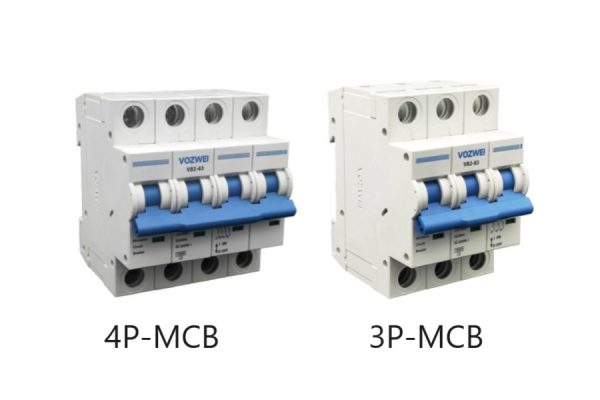 A: 3-pole and 4-pole circuit breakers are common electrical protection devices in power systems. Their main function is to cut off the power supply in a timely manner in the event of a short circuit or overload in the circuit, in order to protect equipment and personnel safety. In practical applications, selecting a suitable 3-pole or 4-pole circuit breaker is crucial for the stable operation and safety of electrical systems.
A 3-pole circuit breaker is typically used in single-phase or three-phase low-voltage systems to protect three-phase circuits. In single-phase low-voltage circuits, a 3-pole circuit breaker is used to control the current level and cut off faulty circuits with rapid current drop; In three-phase low-voltage circuits, 3-pole circuit breakers are used to control current, protect motors, and control cable burning. The 3-pole circuit breaker has the advantages of small size, powerful function, safety and reliability, and convenient use, and is widely used in household, commercial, and light industrial occasions.
Compared to a 3-pole circuit breaker, a 4-pole circuit breaker can not only protect three-phase lines but also cut off neutral lines, making it more applicable. 4-pole circuit breakers are commonly used in industrial electrical equipment and other large power systems, such as power substations, high-rise buildings, etc. In industry, 4-pole circuit breakers are usually used to control equipment such as motors, transformers, frequency converters, etc., in order to cut off the power supply in a timely manner and protect electrical equipment and personnel safety in case of faults.
The selection of 3-pole and 4-pole circuit breakers should be determined based on specific circuit and application requirements. Choosing the correct circuit breaker will help improve the stability and safety of the electrical system, while making the wrong choice will increase the risk of electrical system failures. Therefore, when selecting a circuit breaker, attention should be paid to multiple factors such as its rated current, rated voltage, breaking capacity, operating characteristics, durability, temperature characteristics, environmental conditions, etc., and relevant national standards and specifications should be followed for selection and use.
In summary, suitable 3-pole or 4-pole circuit breakers play a crucial role in the safe and stable operation of electrical systems. In practical applications, the selection should be based on specific circumstances and the correct installation and use should be carried out according to the manufacturer's guidance to ensure the stable and reliable operation of the electrical system.
A: 3-pole and 4-pole circuit breakers are common electrical protection devices in power systems. Their main function is to cut off the power supply in a timely manner in the event of a short circuit or overload in the circuit, in order to protect equipment and personnel safety. In practical applications, selecting a suitable 3-pole or 4-pole circuit breaker is crucial for the stable operation and safety of electrical systems.
A 3-pole circuit breaker is typically used in single-phase or three-phase low-voltage systems to protect three-phase circuits. In single-phase low-voltage circuits, a 3-pole circuit breaker is used to control the current level and cut off faulty circuits with rapid current drop; In three-phase low-voltage circuits, 3-pole circuit breakers are used to control current, protect motors, and control cable burning. The 3-pole circuit breaker has the advantages of small size, powerful function, safety and reliability, and convenient use, and is widely used in household, commercial, and light industrial occasions.
Compared to a 3-pole circuit breaker, a 4-pole circuit breaker can not only protect three-phase lines but also cut off neutral lines, making it more applicable. 4-pole circuit breakers are commonly used in industrial electrical equipment and other large power systems, such as power substations, high-rise buildings, etc. In industry, 4-pole circuit breakers are usually used to control equipment such as motors, transformers, frequency converters, etc., in order to cut off the power supply in a timely manner and protect electrical equipment and personnel safety in case of faults.
The selection of 3-pole and 4-pole circuit breakers should be determined based on specific circuit and application requirements. Choosing the correct circuit breaker will help improve the stability and safety of the electrical system, while making the wrong choice will increase the risk of electrical system failures. Therefore, when selecting a circuit breaker, attention should be paid to multiple factors such as its rated current, rated voltage, breaking capacity, operating characteristics, durability, temperature characteristics, environmental conditions, etc., and relevant national standards and specifications should be followed for selection and use.
In summary, suitable 3-pole or 4-pole circuit breakers play a crucial role in the safe and stable operation of electrical systems. In practical applications, the selection should be based on specific circumstances and the correct installation and use should be carried out according to the manufacturer's guidance to ensure the stable and reliable operation of the electrical system.
3. stage circuit breaker and 4-stage circuit breaker.
Level 3 circuit breakers and level 4 circuit breakers are two different types of protection devices in the power system, which are suitable for different application scenarios.
Level 3 circuit breakers are mainly used in low-voltage electrical systems, including household, commercial, and light industrial fields. They can be used to cut off the current in single-phase or three-phase low-voltage circuits and ensure timely disconnection of the power supply in case of circuit failure, in order to protect the safety of equipment and personnel. In single-phase low-voltage circuits, a 3-stage circuit breaker is usually used to control the current level and cut off faulty circuits with rapid current drops. In three-phase low-voltage circuits, they are used to control current, protect motors, and control cable burning.
Compared to this, a 4-stage circuit breaker can not only protect three-phase lines, but also cut off neutral lines. Therefore, level 4 circuit breakers can be widely used in industrial electrical equipment and other large power systems, such as power substations, high-rise buildings, etc. In the industrial field, level 4 circuit breakers are commonly used to control equipment such as motors, transformers, frequency converters, etc., in order to cut off the power supply in a timely manner in case of faults and protect the safety of electrical equipment and personnel.
When selecting a level 3 or 4 circuit breaker, it is necessary to comprehensively consider the characteristics and application requirements of the circuit. Here are some aspects to consider:
(1). Current load: Confirm the rated current and possible peak current in the circuit. Select the appropriate rated current of the circuit breaker based on the load situation.
(2). Voltage level: Determine the rated voltage of the circuit and select the corresponding circuit breaker rated voltage.
(3). Breaking capacity: Based on the short-circuit and fault currents in the circuit, select a circuit breaker with sufficient breaking capacity to ensure that it can reliably cut off the current.
(4). Action characteristics: Select appropriate circuit breaker action characteristics based on the characteristics of the circuit, such as instantaneous, thermal, or magnetic.
(5). Environmental conditions: Consider the environmental conditions in which the circuit is located, such as temperature, humidity, etc., which affect the performance of the circuit breaker.
In addition, circuit breakers should be selected and installed in accordance with relevant national standards and specifications, and strictly follow the operation manual and maintenance requirements provided by the manufacturer to ensure the normal operation and reliability of the circuit breaker.
In summary, level 3 and level 4 circuit breakers are suitable for low-voltage and high-voltage electrical systems, and their selection should be based on the characteristics and application requirements of the circuit. By selecting and using appropriate circuit breakers, it is possible to ensure the safe and stable operation of the electrical system, protect equipment, and prevent personal injury.